









How to list a project on Crypthub platform
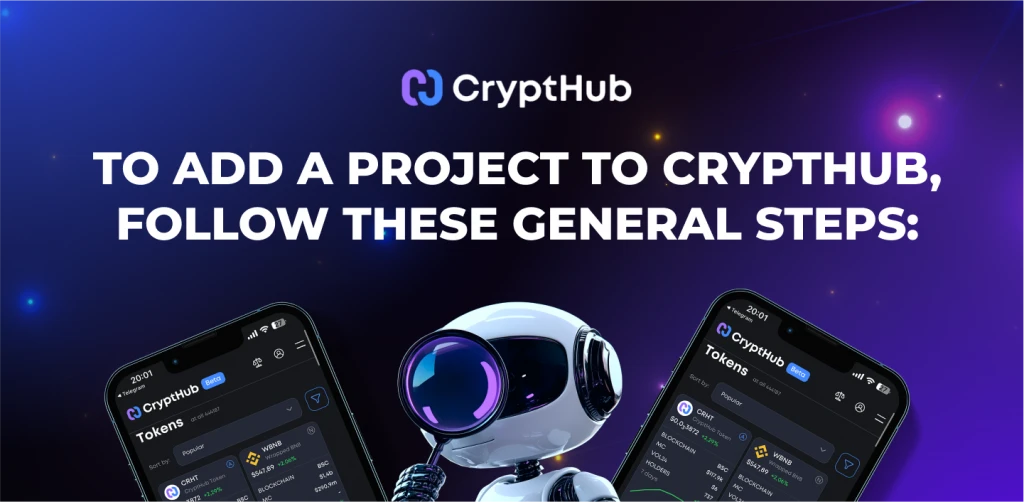
To add a project to Crypthub platform follow these general steps
6
3

$0,0₉2281
BASE
$11,4K
$9,3
10,4K
Zobacz wszystko
CryptHub is the first social marketing platform based on AI, created for blockchain and web 3.0 project owners and potential investors.
The purpose of the CryptHub platform is to unite the coin owners with the investors in the community and to collect as much information as possible in one place.
The website visitor can follow the latest news on the crypto market:
- find an active token and add it to a comparison with other tokens;
- follow the dynamics of price growth/fall in existing pairs;
- get information about the token from the owner (his representative);
- create topics or participate in already existing discussions;
- connect a wallet and buy a coin that interests him.
All this and more is available in one place, on the CryptHub platform.
Czytaj więcej
The owner can authorize his token on the CryptHub platform and promote it through active community use and blogging. Here he can promote his project by creating a community with potential investors. You can also create a block with answers to frequently asked questions for maximum informativeness about your token. Add current news, create daily tasks, and provide information about project development prospects. The owner of the project will have access to complete statistics related to his token: a graph of the visits number to the token's page, a coin sale/purchase schedule, the dynamics of daily tasks, and much more.
In summary, we can say that the CryptHub platform is an ideal place for the distribution of both already popular tokens and newly created projects.
Czytaj więcej
The advantage of using the CryptHub platform for investors is that the maximum amount of information about a particular token is collected in one place. On CryptHub, you can find an active token, see pricing dynamics, add it to a comparison with other tokens, and even buy a token among existing pairs. After registration, additional opportunities are opened, including participation in the community. An investor can participate in existing discussions, create topics for discussion, and even get answers to emerging questions from the token owner.
Czytaj więcej
You can register in several ways:
1. Using a Google Account. By pressing the "Continue with Google'' button on the registration form, you can create a user account. The automatically generated password will be sent to your email and a suggested nickname (which you can change immediately) will be given. Then, if desired, the user can upload an avatar, connect two-factor authentication, or complete registration.
2. Using e-mail. To do this, you need to enter your e-mail in the appropriate field and follow the prompts to confirm your email by entering the received code. Then the user creates a password himself or can tick the box so that the password is generated by the system. After confirming the password, the user changes or leaves the offered nickname, uploads an avatar (optional), enables two-factor authentication, or completes registration.
Czytaj więcej
For the user to protect his account from intruders, it is possible to connect additional protection in the form of two-factor authentication. You can connect 2FA in two ways:
- immediately upon registration
- in the personal account by clicking on the corresponding button "Connect two-factor authentication".
To use 2FA, you need to install Google Authenticator on your phone. Next, link it to your CryptHub account using a QR code or a 16-digit key. Enter the appropriate verification codes to complete the additional protection installation process.
You can disable two-factor authentication in your account anytime you want.
Czytaj więcej
To search for a token, you can use several options:
- if the user knows the name or smart contract, then by entering these data in the search field, you can find the token;
- or the user can search for tokens that have certain parameters (blockchain, category, industry, algorithm, and parameters) by writing the appropriate filter criteria in the token catalog.
Czytaj więcej
To create topics or comment on already existing discussions, the user must be registered/authorized. You can create a topic on the token page in the community block or in the community feed of a certain token by clicking on the "Create topic" button. When creating a topic, the user must enter the title of the topic (a summary of the discussion), and, if desired, can specify additional information (description of the topic), and add media files (photo, video, and PDF file). The user can create any number of topics in any tokens he is interested in.
Czytaj więcej
To authorize the token, the token's owner should open the "Own projects" tab in his account and, using the prompts, must go through several stages:
1. Confirm ownership of the token using a smart contract. To do this, you need to insert a smart contract in the appropriate field. If the smart contract passes the check (it is in the database and not yet authorized), the button to connect the wallet will appear.
2. Connect the owner's wallet. If the verification is successful (the owner's wallet matches), the "Confirm" button is activated. After clicking the "Confirm" button, an additional window will appear where the user must sign up using the wallet. And already after signing up, ownership is confirmed and the owner can proceed to the next points to fill in the information.
3. Fill in the primary information about the token. The token owner must fill in the information in three categories: “Token parameters”, “Project description”, and “FAQ”. After filling in the mandatory data in each of the categories, a green tick appears next to it. When all the ticks light up, the "Authorize" button is activated. Click on it to complete the authorization process.
After the authorization is completed, the token owner can grant the right to manage the token to other persons (with full or limited access to the items being edited). Also, the owner can create daily tasks, monitor the dynamics of their execution, and see statistics of token visits by other users.
Czytaj więcej